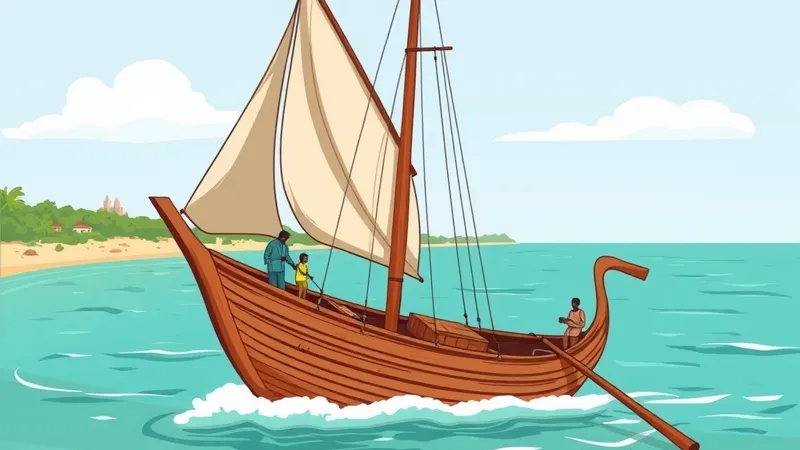
What is a dhow in Swahili coastal history?
A dhow is an umbrella term for several traditional Indian Ocean vessel types, often associated with lateen sails, rather than one exclusively Kenyan boat design. Along the Swahili coast, these boats carried people, fish and trading cargo between coastal settlements and across the ocean.
Their history belongs to working coastal communities as much as to long-distance commerce. Boatbuilders, sailors, fishers and merchants adapted vessels to local waters, available materials and changing livelihoods.
Visitors encounter the name on Wasini excursions from Diani Beach because wooden excursion boats draw on this maritime tradition. However, “dhow trip” does not identify a precise hull design or guarantee sailing. Diani Excursions is an independent editorial comparison guide funded through affiliate links—not a tour operator, boat owner or safari provider.
How did dhows connect the Swahili coast with the Indian Ocean?
Dhows helped connect East Africa with Arabia, Persia and India through coastal transport and ocean-going commerce. These maritime connections supported the movement of goods and people, as well as cultural exchange.
UNESCO’s accounts of Lamu Old Town and the Stone Town of Zanzibar describe coastal societies shaped by African foundations and sustained overseas connections. Swahili culture was not simply imported from elsewhere.
Zanzibar’s documented history also includes the slave trade. Maritime history should acknowledge that coercion alongside commerce and cultural exchange, rather than presenting every voyage as a benign encounter.
These town histories illuminate the world in which vessels worked. They do not establish a single birthplace for the dhow or prove the ancestry of an individual boat design. Erik Gilbert’s study of Zanzibar’s dhow economy examines these vessels’ commercial role through economic and transport change.
How were traditional dhows built and sailed?
Traditional dhows were wooden vessels, but their construction and sailing arrangements varied across places and periods. The name does not establish a particular fastening method, timber or hull shape.
A short glossary helps explain the boat without treating every vessel as identical:
- Hull: the boat’s main body.
- Planking: the boards forming its outer skin.
- Mast: the upright support for the sailing rig.
- Yard: the long spar supporting the sail’s upper edge.
- Lateen rig: an arrangement commonly associated with a triangular sail carried on an angled yard.
The familiar sloping yard is a useful visual clue, not a complete classification system. Nor does a traditional-looking hull establish whether an excursion boat has a working sailing rig.
Are dhows, jahazis and mashuas the same boat?
Not exactly: dhow is the broad label, while jahazi and mashua are locally used vessel names whose meanings vary between sources and communities.
A. H. J. Prins’s maritime ethnography, Sailing from Lamu, examines vessel terminology within a working coastal culture rather than as interchangeable tourism labels.
Neither local name alone establishes a particular bow, stern, fastening method or present-day rig. Avoid treating them as fixed size categories or assuming that every boat marketed as a dhow has the same construction. Keep the names jahazi and mashua unchanged when discussing them across languages.
How did monsoon winds shape dhow journeys?
Seasonal wind reversals helped determine sailing directions, departure windows and the length of trading stays. Crews worked with prevailing winds and coastal geography rather than following a fixed year-round schedule.
The kaskazi, the northeast monsoon, generally falls between November and March or April. The kusi, the southeast monsoon, generally runs from April or May through October. These are approximate climatological ranges, not precise annual changeover dates.
Broadly, kaskazi conditions are associated with calmer seas and clearer underwater visibility, while kusi conditions tend to be rougher. The Kenya Meteorological Department provides regional weather and climate context; historical maritime scholarship explains how sailors used seasonal opportunities.
Neither historical sailing patterns nor seasonal averages establish the sea state, visibility or suitability of a future snorkeling excursion. Conditions require assessment on the day.
What does a dhow day trip near Wasini involve today?
A typical excursion combines a road transfer, embarkation around Shimoni, a boat journey towards Kisite-Mpunguti, snorkeling stops and a meal. The sequence and inclusions vary by listing.
Modern excursion dhows may use engines throughout. Booking a dhow does not necessarily buy time under sail, and “Wasini trip” does not necessarily include landing on Wasini Island.
The Kenya Wildlife Service is the official source for the marine protected-area context. For booking differences, see the Wasini dhow guide from Diani and the Kisite private dhow guide.
Potential drawbacks include a long transfer, tide-dependent snorkeling and crowded group departures. Distinguish advertised island experiences from the actual itinerary.
How do you reach the dhow departure from Diani Beach?
You normally travel south by road to Shimoni, then board at the embarkation point specified by your operator. A general Diani-to-Shimoni estimate is not a measured route from your particular hotel.
Use this route checklist rather than assuming a universal timetable:
- Named pickup point: obtain your hotel entrance or meeting-point name in writing.
- Shimoni embarkation: request the exact jetty or boarding meeting point.
- Road distance: about 55 km from Diani to Shimoni; the actual route depends on pickup location.
- One-way driving estimate: 1–2 hours, traffic-dependent.
- Advertised trip duration: check the selected listing, including transfers and the return estimate.
Road distance is separate from the boat journey. Hotel pickup, arrival at the coast and boarding are different events; tides and itinerary changes can affect the sequence.
Confirm boarding steps, movement between jetty and boat, toilets, shade and mobility access. Ask whether lunch is aboard or ashore and whether reaching it requires another transfer or uneven walking.
What should you check before choosing an excursion?
Check the actual vessel, supervision and inclusions—not just the word dhow.
- Appropriately sized life jackets and the passenger limit.
- Snorkeling supervision, swimming requirements and support for beginners.
- Shade, drinking water and toilet arrangements.
- Dietary requirements and the meal location.
- Transfer coverage, cancellation terms and weather-related changes.
Wildlife sightings are never guaranteed. Dolphins may be seen frequently on some routes, but no operator can promise them. Do not book on the assumption that turtles, seasonal humpback whales or dugongs will appear.
Do not touch or stand on coral, feed animals or pressure crews to chase wildlife. Kenya Wildlife Service and Kenya Marine and Fisheries Research Institute provide conservation and marine research information.
Compare private and group Wasini trips to weigh crowding, flexibility and inclusions. Check the GetYourGuide widgets on the comparison pages for live prices and ratings; affiliate links help support this independent guide.
Where can visitors learn about living dhow traditions?
Working harbours and maritime heritage institutions offer context beyond excursion marketing. Boats and boatbuilding remain part of coastal livelihoods, not merely visitor scenery.
Ask before photographing crews, entering workshops or approaching a vessel under repair. Do not assume a working boatyard offers public access or sailing demonstrations.
Lamu is a separate Kenyan coastal destination, not a nearby Diani day trip. Its UNESCO-listed town and the Lamu museums administered by the National Museums of Kenya offer opportunities to learn about Swahili coastal culture.
What do visitors ask about Swahili dhows?
Is a dhow a specifically Kenyan invention, and do all dhows use sails?
No. Dhow describes a wider Indian Ocean family of vessels, not a uniquely Kenyan invention. Some retain working sails; others rely on engines.
Will a Wasini excursion sail and land on the island?
Not necessarily. Confirm both separately: a wooden dhow may travel entirely under engine, and the itinerary may not include an island landing.
Can non-swimmers join?
Sometimes, subject to the operator’s rules and available support. Boat participation and snorkeling eligibility are separate questions; disclose swimming ability before booking.
Are Diani transfers included, and are dolphins guaranteed?
Transfers depend on the listing and pickup area. Dolphins—and all other wildlife—are never guaranteed, regardless of how frequently they are encountered.
Where should I check current prices?
Use the live GetYourGuide widgets on the excursion and comparison pages. Check transfer coverage, meals and park-entry arrangements before comparing totals.
Sources
These sources provide historical, maritime and environmental context; they do not establish an individual excursion’s current arrangements.
- UNESCO World Heritage Centre: the Lamu and Zanzibar entries linked above document Swahili urban history and cultural connections. Zanzibar’s entry also discusses the slave trade. Neither entry classifies individual boat designs.
- National Museums of Kenya: information about Kenya’s museums and coastal cultural heritage, including Lamu.
- A. H. J. Prins, Sailing from Lamu: A Study of Maritime Culture in Islamic East Africa. Van Gorcum: maritime ethnography covering coastal vessels, terminology and sailing culture.
- Erik Gilbert, Dhows and the Colonial Economy of Zanzibar. Ohio University Press: historical scholarship on dhow commerce and economic and transport change.
- Kenya Meteorological Department: regional climate and weather information; climatology is not an excursion forecast.
- Kenya Wildlife Service: official protected-area and wildlife conservation information.
- Kenya Marine and Fisheries Research Institute: research on Kenya’s marine ecosystems.