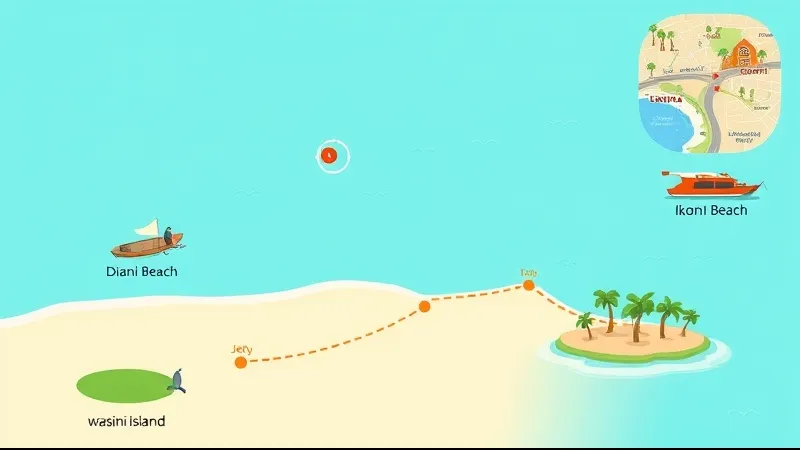
Wasini Island is reached from one place only: the jetty at Shimoni, on Kenya's south coast. From Diani Beach the road journey is about 55 km and takes roughly one to two hours depending on traffic. From Mombasa it is about 90 km and around two hours, using the Likoni ferry and the A14 highway. Both routes deliver you to the same jetty, the same dhows and the same Kisite-Mpunguti Marine National Park and Reserve, so the difference is not the experience on the water — it is the transfer time, the hour you are collected and how long your day lasts door to door. Operators typically collect guests in Diani around 07:15 and in Mombasa between 5:45 and 7:20, with boarding at Shimoni around 9:00. Tour prices are shown live in the GetYourGuide widgets on the excursion pages, and marine park fees are set by Kenya Wildlife Service and should be checked on kws.go.ke.
Is it better to visit Wasini Island from Diani or from Mombasa?
Diani is the shorter and simpler base. It sits on the same side of the water as Shimoni, so no ferry crossing is involved, the drive is the shortest of the two and the pickup is the latest of the day. Mombasa is entirely doable but adds either the Likoni ferry crossing or the Dongo Kundu bypass, and that extra road time is absorbed by leaving earlier rather than by arriving later at the jetty.
The part that surprises most first-time visitors is that leaving earlier from Mombasa does not buy more time in the water. Boats leave Shimoni on a common mid-morning schedule tied to the tide and to the marine park programme, so a 5:45 pickup and a 07:15 pickup converge at the same boarding time. If you are weighing the two departures side by side, our Diani vs Mombasa comparison lays out the same trade-off in table form.
How far is Wasini Island from Diani Beach?
About 55 km by road from Diani to Shimoni, realistically one to two hours depending on traffic. The route runs south from Ukunda through Msambweni and Ramisi, then turns off the main highway for the final stretch down to the Shimoni jetty. The variables are predictable: town traffic through Ukunda and Msambweni, matatus stopping without warning, speed bumps through built-up sections and police checkpoints along the highway.
From the jetty, the boat crossing to Wasini is short — 15 to 20 minutes. Wasini lies only about 3 km off the coast, and roughly 75 km south of Mombasa in a straight line. The crossing time is a function of the boat and the tide, not of where your day started: a guest picked up in Nyali and a guest picked up in Galu sit on the same dhow.
One practical detail for Diani guests: pickups are usually run as a loop, so a hotel at one end of Diani Beach Road may be collected noticeably earlier than one at the other end, and properties in Galu or Kinondo can add time to that loop. Ask your accommodation where it falls on the circuit rather than assuming the advertised pickup hour applies to you. Our transport overview covers how these transfers are generally organised on the south coast.
How far is Wasini Island from Mombasa?
About 90 km from Mombasa to Shimoni, around two hours, via the Likoni ferry and the A14 highway. There are two realistic routings out of the city. The classic one crosses from Mombasa island to the south coast on the Likoni ferry and then follows the A14 south. The alternative is the Dongo Kundu bypass, which links the western mainland side of Mombasa to the south coast road without using the ferry at all.
Which one your operator uses depends on the hour and on current road status, and it is the main reason two people booking what looks like the same product can report different journeys. Road classification and any current works on these routes are published by the Kenya National Highways Authority — worth a look before travelling, since the practical drive time is a road-status question more than a distance question. Road conditions referenced here were verified July 2026.
Pickups from Nyali, Bamburi, Shanzu and Kikambala are usually the earliest of the whole day for a simple reason: they are furthest from the jetty and they sit on the wrong side of the ferry or the bypass, so the operator builds a buffer into the schedule to protect a boarding time it cannot move. If you are booking from the north coast, look at the Mombasa departure rather than assuming a Diani product will collect you.
What is the road to Shimoni actually like?
The spine of the journey is the A14 Mombasa–Lunga Lunga highway, a tarmac road in broadly serviceable condition that carries everything from tourist minibuses to heavy freight heading for the Tanzanian border. You pass through Ukunda, then Msambweni, then Ramisi, before the turn-off that leads down to Shimoni.
What slows you down is rarely the surface. It is the speed bumps at every settlement, matatu and boda-boda traffic in the towns, and the occasional checkpoint. The final stretch from the highway to the jetty is narrower and quieter, and it is the section most affected during the long rains, along with the unsurfaced access roads at some coastal hotels. If you are travelling in the wetter months, allow more margin than the map suggests. For the official road classification and any works in progress, KeNHA is the authoritative source; the condition described here was verified July 2026.
Do you still need the Likoni ferry, and how does the Dongo Kundu bypass change it?
Not necessarily — but if your operator routes through Likoni, you will use it. The Likoni crossing, operated by Kenya Ferry Services, has historically been the bottleneck between Mombasa island and the south coast. Foot passengers cross free of charge; vehicles pay a fee. At peak commuter hours the queues are unpredictable, which is precisely why early-morning tour departures aim to be through before the city wakes up.
The Dongo Kundu bypass changed the calculation. It connects the western mainland of Mombasa to the south coast road without a ferry crossing, and a number of operators now route Mombasa pickups that way to remove the single most variable element of the journey. It is longer in kilometres and generally more predictable in minutes.
Before you travel, verify current ferry operating hours and vehicle fees with Kenya Ferry Services, and current bypass status with KeNHA — both were verified July 2026 for this guide, and both are exactly the kind of detail that changes without notice.
What time does a Wasini day trip start from each base?
Earlier from Mombasa, later from Diani, with the same boat. A realistic comparative timeline looks like this:
- Mombasa and north coast: pickup between 5:45 and 7:20, depending on where you are staying and which routing is used.
- Diani and the south coast: pickup around 07:15.
- Both: boarding at Shimoni around 9:00, then the crossing and the marine park programme.
- Both: return to the jetty in the late afternoon, followed by the same road transfer in reverse.
The departure hour from the jetty is not an operator preference. It is set by the tide and by the marine park programme — according to local operators, snorkelling is at its best in roughly the two hours around low tide, which is why boarding times shift through the month rather than sitting on a fixed clock. The practical consequence: an earlier pickup from Mombasa does not mean more time in the water, only more time in the vehicle at both ends of the day.
How do the costs compare between a Diani and a Mombasa departure?
Three separate things make up the cost, and only one of them changes with your base.
- The tour fare. Shown live in the GetYourGuide widget on each excursion page. As a starting point, the Diani dhow day trip starts from around €80 and the Mombasa departure from around €118 (verified July 2026) — the gap reflects the longer transfer, not a different boat or a different itinerary. Always read the live figure and the inclusions in the widget rather than a number in an article.
- The marine park fee, charged by Kenya Wildlife Service. Under the 2025 tariff — in force but contested in court, with a High Court case open — non-residents pay USD 25 per adult and USD 15 per child; Africans who are not EAC citizens pay USD 15 and USD 10; EAC citizens pay KES 500 and KES 250; Kenya residents pay KES 675 and KES 350. Park hours are 6:00 to 18:00 and payment is handled through eCitizen. Verified July 2026 — check the current tariff on kws.go.ke before you travel. This fee is identical whichever base you leave from. Operators also state a dhow supplement inside the park of KES 1,000 / USD 10.
- Transfer supplements. Pickups north of Diani are commonly handled either as a supplement or as a separate departure product, which is why the two listings exist at different starting prices.
Be honest with yourself about the shape of the day, too. Group Wasini trips run at scale, and some mass-market versions of this excursion attract "tourist trap" complaints — crowded boats, rushed snorkelling stops, a lunch served on a conveyor belt. That is exactly why it is worth comparing what is included before booking, and why a private dhow cruise exists as an alternative for people who want a smaller boat and a slower pace.
Which base suits which traveller?
Staying in Diani, Galu, Tiwi or Msambweni means the shortest transfer, the latest pickup and the most manageable day. Staying in Mombasa, Nyali, Bamburi, Shanzu or Kikambala means an early start and a long day that is still perfectly doable — thousands of visitors do it every season — but it is a full day committed to a single excursion.
A few honest distinctions:
- Families with young children. The road transfer, not the boat, is usually the hard part. From Diani it is a manageable stretch either side of the day; from the north coast it is a pre-dawn start and a late return, which is a lot to ask of a small child.
- Travellers prone to motion sickness. You face two separate challenges — a winding, speed-bumped road and a boat — and the Mombasa departure doubles the road exposure. Take precautions before departure, not once you are already unwell.
- One free day only. If Wasini is the single excursion you will make and you are based in Mombasa, it is worth doing. If you have several days on the south coast, Diani is simply the more efficient base for Shimoni-based excursions generally, and leaves room for a second trip such as a Tsavo East day safari.
What happens once you reach Shimoni?
The pattern is consistent whichever base you left from. You register at the jetty, board a dhow or a speedboat, and cross towards the Kisite-Mpunguti Marine National Park and Reserve. The park was established in 1978, covers roughly 39 km² in total, and has recorded some 252 fish species and around 56 genera of hard corals, along with green and hawksbill turtles. It received a gold-level Blue Park Award in 2021.
The day usually includes snorkelling stops inside the park, time on Wasini village, and a Swahili seafood lunch — grilled fish, coconut rice, spiced sauces, prepared in the village rather than in a hotel kitchen. Many trips also include the coral garden boardwalk, roughly 500 m of walkway over fossil coral and mangroves run by the Wasini women's community group, with an entry fee of around KES 200 reinvested in the village clinic and school. At high tide, parts of the gardens are covered.
On wildlife, be clear-eyed. Peer-reviewed research carried out between 2011 and 2019 identified around 182 resident Indo-Pacific bottlenose dolphins and around 104 Indian Ocean humpback dolphins — an endangered species — and found the Kisite-Mpunguti area to have the highest number of recorded dolphin sightings on the Kenyan coast. Humpback whales pass along the coast between July and December, with a peak from August to October. Sightings are frequent, but no operator can guarantee them, and nobody — including this guide — can tell you what the sea will be like on your particular day.
When is the best time of year to make this trip?
Seasonality on this coast follows the monsoons. The kaskazi monsoon, blowing from the north-east between November and March or April, brings the drier weather, the calmer seas and the best underwater visibility. The kusi monsoon from the south-east runs from around April or May through October, with the long rains falling between April and June and generally rougher water. In practice, the most reliable snorkelling window runs from October to March, peaking in January and February, while May and June are the least favourable. Sea temperature stays between 23 and 27°C year-round.
July to October pulls travellers for a different reason: it overlaps the humpback whale migration window. Treat that as a possibility rather than a promise. For rainfall seasons and official forecasts, the Kenya Meteorological Department is the source worth consulting rather than a travel blog, and general destination information is published by Magical Kenya, the Kenya Tourism Board.
What should you take for a full-day trip from either base?
- Reef-safe sunscreen and a hat — you will be on open water for a large part of the day.
- A light layer for the boat; the wind is cooler than the beach suggests.
- Motion-sickness tablets taken before departure, not once you are on the water.
- A dry bag for phone, documents and camera.
- Cash in Kenyan shillings for park fees, the boardwalk entry and extras.
- A printed or offline copy of your booking, since mobile signal is patchy near the jetty.
If you are travelling from Mombasa or the north coast, add water for the road, and ask your hotel for an early breakfast box the night before — at a 5:45 pickup the kitchen will not be open. On entry requirements, most visitors need a Kenya eTA, which costs USD 30, is non-refundable, is valid 90 days for a single entry, takes up to 72 hours to process and should be applied for only through the official site etakenya.go.ke. For vaccination and malaria guidance, consult the CDC Kenya travel page and your own doctor rather than any travel article.
If you are still deciding between the two departures, read the side-by-side breakdown on our Wasini from Diani vs Mombasa comparison page, where the live prices and inclusions for both products sit next to each other.
Frequently asked questions
Can you do Wasini as a day trip from Mombasa?
Yes. Mombasa to Shimoni is about 90 km and around two hours by road via the Likoni ferry and the A14, or via the Dongo Kundu bypass. Pickups from Mombasa run between 5:45 and 7:20 so that guests reach the jetty for boarding at around 9:00, the same boarding time as guests collected in Diani around 07:15. It is a long day, not a difficult one. Prices and inclusions are shown live in the GetYourGuide widget on the excursion page.
Is there a ferry involved?
Only from Mombasa, and only if your operator routes through Likoni. The Likoni crossing links Mombasa island to the south coast, is free for foot passengers and charges a fee for vehicles, and is run by Kenya Ferry Services. The Dongo Kundu bypass reaches the south coast without a ferry, and some operators now prefer it for that reason. From Diani, no ferry is involved at any point. Verify current hours and fees with Kenya Ferry Services before travelling.
How long is the boat crossing to Wasini?
Fifteen to twenty minutes from Shimoni. Wasini lies only about 3 km offshore. The crossing is the same length whichever base you were collected from — the difference between a Diani and a Mombasa booking is entirely in the road transfer, not on the water.
Are dolphins guaranteed?
No. Sightings around Kisite-Mpunguti are frequent — research conducted between 2011 and 2019 recorded the highest number of dolphin sightings on the Kenyan coast in this area, identifying around 182 Indo-Pacific bottlenose dolphins and around 104 Indian Ocean humpback dolphins — but no operator can promise an encounter, and any that does is overselling. The same applies to humpback whales, which pass between July and December with an August to October peak, and to turtles.
Do you pay the park fee separately?
Usually yes, and you should assume so unless the widget states otherwise. The Kisite-Mpunguti conservation fee is charged by Kenya Wildlife Service, not by the operator, and it is the same amount whether you left from Diani or from Mombasa. Under the 2025 tariff — in force but contested in court — non-residents pay USD 25 per adult and USD 15 per child, with lower rates for EAC citizens and Kenya residents, payable via eCitizen (verified July 2026). Check the current tariff on kws.go.ke and read the inclusions in the GetYourGuide widget on the tour page before booking.
Sources
- Kenya Wildlife Service (kws.go.ke) — Kisite-Mpunguti Marine National Park and Reserve status, park hours and conservation fees. Verified July 2026.
- Kenya National Highways Authority (kenha.co.ke) — A14 Mombasa–Lunga Lunga highway classification, the Dongo Kundu bypass and current works. Verified July 2026.
- Kenya Ferry Services (kenyaferry.co.ke) — Likoni crossing operations, passenger and vehicle charges. Verified July 2026.
- Kenya Meteorological Department (meteo.go.ke) — seasonal rainfall and monsoon patterns on the Kenyan coast. Verified July 2026.
- Magical Kenya / Kenya Tourism Board (magicalkenya.com) — official destination information for the south coast. Verified July 2026.
- Kenya eTA official portal (etakenya.go.ke) — entry authorisation requirements, cost and processing time. Verified July 2026.
- CDC Travelers' Health — Kenya — vaccination and malaria guidance. Verified July 2026.
- Peer-reviewed photo-identification research on Indo-Pacific bottlenose and Indian Ocean humpback dolphin occurrence in the Kisite-Mpunguti area, based on surveys conducted between 2011 and 2019.